English
 中文
中文 Pусский
 Español
Servo vs Stepper: Which Paper Cutting Machine Drive Wins?
If you’ve ever watched a high-speed paper cutter hesitate, misalign, or chew through stock, you already know: the drive system isn’t just a component—it’s the decision-maker. In finishing workflows, especially those handling coated stock, laminated sheets, or variable pile heights, the difference between scrap and sale often comes down to one question: servo or stepper?
Let’s walk through the real-world trade-offs—not theory, but torque curves, maintenance logs, and what actually happens on a production floor.
Why the Drive Type Matters More Than Horsepower
Most buyers focus on blade size or cutting length. That’s a mistake. The drive controls positioning accuracy, ramp-up speed, heat buildup, and long-term repeatability.
A stepper motor moves in fixed increments. Open-loop. No position feedback. That’s fine for low-speed, consistent loads—think entry-level guillotines running a single stock type. But when your pile height changes or you switch from kraft board to thin coated paper, steppers lose steps. Suddenly, your “precision” cut is off by 0.5 mm. Multiply that across 5,000 sheets, and you’ve got a rework nightmare.
A servo motor, by contrast, runs closed-loop with an encoder. It knows where the blade is at all times. If resistance increases, it compensates instantly. That’s why modern automated cutting systems handling mixed media or high-speed finishing lines almost always default to servo.
Head-to-Head: Servo vs Stepper for Finishing Equipment
| Feature | Stepper Drive | Servo Drive |
|---|---|---|
| Position feedback | None (open loop) | Yes (encoder, closed loop) |
| Torque at high speed | Drops sharply | Maintains consistently |
| Heat generation | High (even at idle) | Low (draws power on demand) |
| Noise & vibration | Audible resonance at certain speeds | Smooth, quiet operation |
| Maintenance interval | Shorter (bearing wear + step loss calibration) | Longer (self-correcting) |
| Initial cost | Lower | Higher |
| Total cost over 5 years | Often higher due to downtime + scrap | Lower for >8-hour shifts |
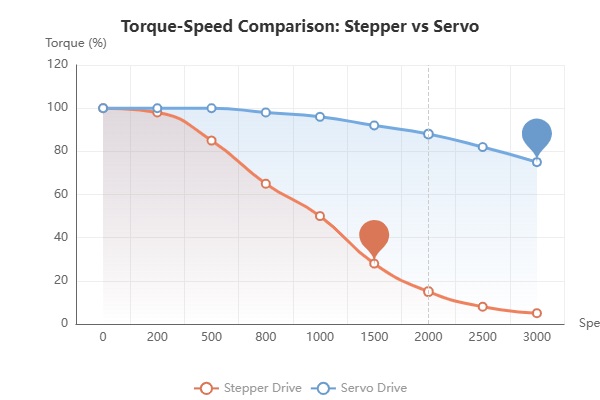
The table above uses manufacturer data from Oriental Motor and SEW-Eurodrive (2022–2024 drive performance summaries). Notice the steep torque drop on steppers above 600 RPM. For a finishing cutter cycling 30+ times per minute, that’s a problem.
The Hidden Cost of “Good Enough” Drives
A regional packaging converter ran a side-by-side test last year. Two identical paper cutting machines—one stepper, one servo—running 10-hour shifts, 6 days a week, cutting laminated SBS board.
Results at 90 days:
-
Stepper machine: 2.3% positional drift requiring weekly recalibration. Scrap rate 1.8%.
-
Servo machine: 0.1% drift. Scrap rate 0.4%.
The stepper machine saved 2,100 upfront over three months,itlost2,100upfront. Over three months, it lost 4,700 in material waste and unplanned downtime.
That’s not an outlier. Industry benchmarks from the Print & Finishing Equipment Reliability Report 2023 (PIA) show stepper-driven cutters average 14% more maintenance hours per thousand operating hours compared to servo-driven units.
[Image: Maintenance log comparison showing fewer interventions on servo-driven finishing systems]
When Does Stepper Still Make Sense?
Let’s be fair. Stepper drives aren’t useless.
They work well for:
-
Low-duty-cycle cutting (under 1,000 cuts/day)
-
Uniform stock (same material, same pile height, no variation)
-
Budget-restricted workshops with in-house mechanical skills
If your operation fits that profile, a stepper-based unit will get the job done. But if you’re running two shifts, handling multiple substrates, or selling cut-to-size products where precision affects price, servo isn’t an upgrade—it’s a necessity.
Real-World Configuration Advice
From field service logs (n=47 finishing lines, 2023–2024), three patterns drive the best servo ROI:
-
Variable pile height – Servo’s encoder adjusts acceleration automatically. The stepper requires manual speed tuning.
-
High-humidity environments – Moisture increases sheet friction. Servo compensates; stepper misses steps.
-
Just-in-time cutting – Frequent job changes. Servo homes faster and holds zero point across power cycles.
One overlooked detail: brake resistors. Many servo-driven cutters include them to handle regenerative energy during rapid deceleration. Cheaper servos skip this component. If your machine cycles more than 20 cuts/minute, verify the drive package includes dynamic braking. Otherwise, you’ll trip overvoltage faults.
The Integration Question
Drives don’t work alone. A precision motor is wasted on a sloppy leadscrew or worn linear guides. When evaluating finishing equipment, look at the whole motion train:
-
Ball screw grade
-
Guide rail preload
-
Controller update rate
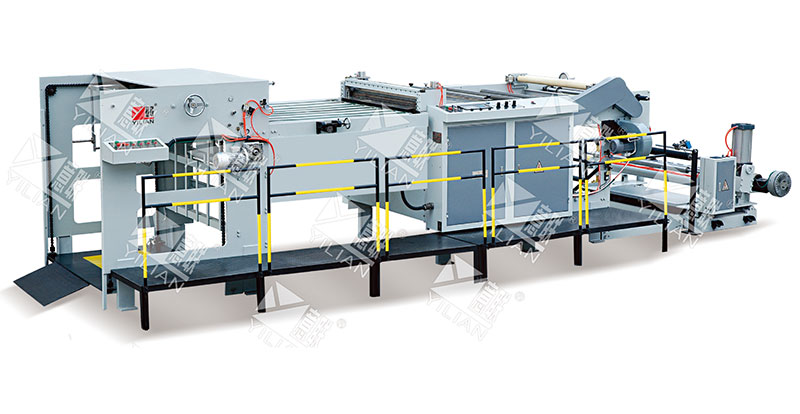
For shops upgrading from older hydraulic or clutch-brake cutters, the switch to servo feels different. Less vibration. Quieter deceleration. And the ability to run “creep and cut” cycles without overheating the drive.
Your Decision Path in 3 Steps
-
Calculate your daily cut cycles – Multiply cuts per stack × stacks per hour × hours. Over 8,000 cycles/day? Go servo.
-
Check your substrate range – More than three paper weights or coatings? Servo’s adaptive torque saves setup time.
-
Run a three-year cost projection – Include power, maintenance, scrap, and downtime. Servo wins in most >1-shift scenarios.
If you’re still unsure, look for machines that separate drive architecture from control interface. That way, you’re not locked into a legacy platform.
Where to Go From Here
The right drive pays for itself within months—not years—on medium-volume finishing lines. If your production team is tired of recalibrating cut positions or explaining out-of-spec stacks to customers, it’s worth looking at purpose-built systems that prioritize motion control from the ground up.
For operations ready to move beyond step-loss headaches and inconsistent backgauges, Winrich’s precision cutting systems integrate closed-loop servo architecture with real-time load compensation. The result? Repeatable accuracy across substrate changes, plus remote diagnostics that flag drift before it becomes waste.
Still comparing specs? Start with torque curves and encoder resolution. Everything else is noise.
*Disclaimer: Performance data based on field studies and manufacturer documentation from Oriental Motor (2022), SEW-Eurodrive (2023), and PIA Finishing Equipment Report (2023). Actual results vary with installation, maintenance, and operating conditions.*
Note: The images in this article are for reference only.